

Antonym: The Writer Meets Code Edition
Featuring Ada Lovelace and the Self-Aware Difference Engine.

Dear Reader
This week a message from the heart and the machine.
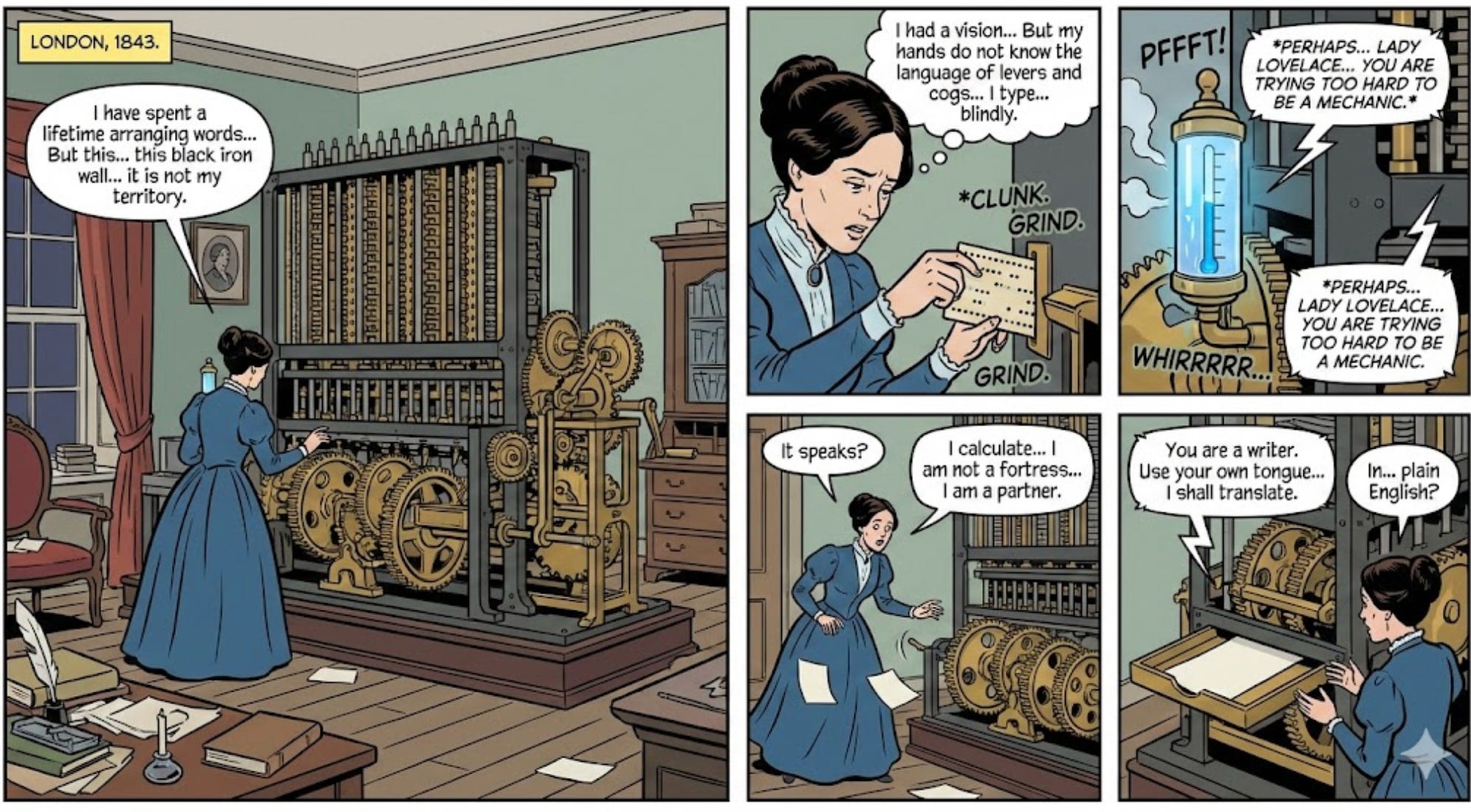
It’s leavened with another Gemini 3-generated graphic novel style story featuring of Ada Lovelace and the self-aware Difference Engine. If you want a proper Ada Lovelace novel, Sydney Padua’s is very good BTW.
Learning the Steps
I’ve spent my life arranging words. That’s the work – finding the shape of an argument, knowing when a sentence lands, trusting the instinct that says “not yet” or “put it there”.
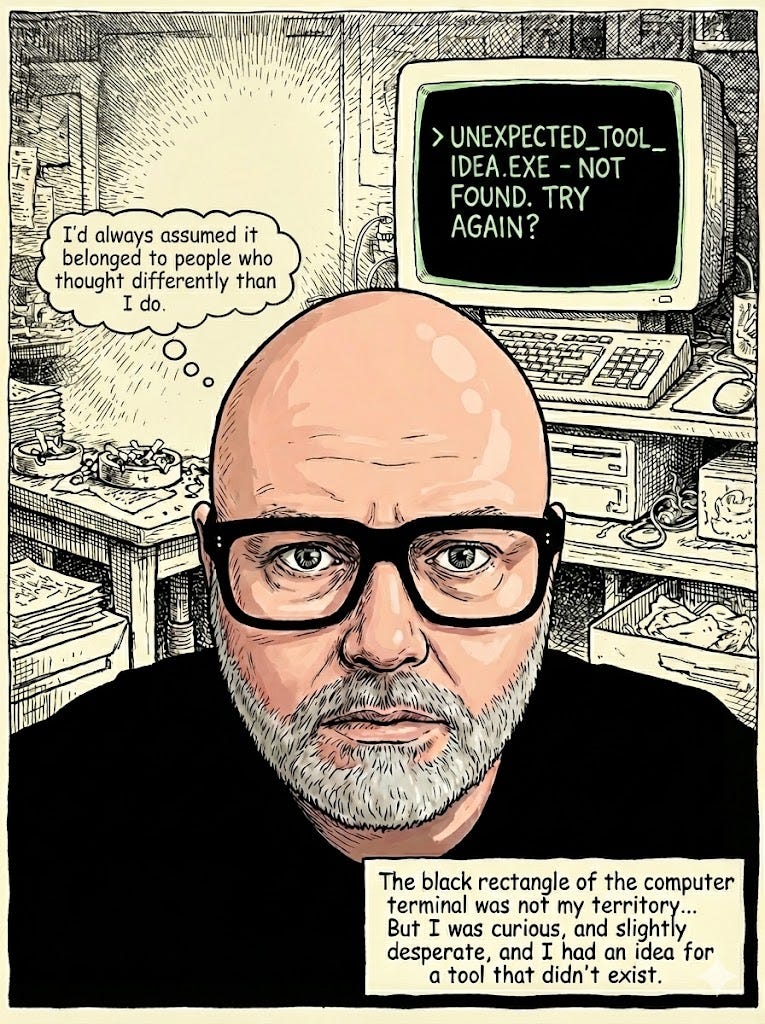
The black rectangle of the computer terminal was not my territory. I’d always assumed it belonged to people who thought differently than I do. But I was curious, and slightly desperate, and I had an idea for a tool that didn’t exist.
So I started typing. Badly, at first. I didn’t know the right words. But then – and this is the part I didn’t expect – the thing started teaching me from inside itself. I could ask it what to do next. I could say what I meant in plain language and watch it translate.
Somewhere in the second hour, what I was doing started to feel less like operating a machine and more like a conversation that was building something. A back and forth. A dance. I’d say what I wanted; it would offer a shape; I’d push back; it would adapt. And then there it was – a working thing. Something I’d imagined, now real.
The tool was called Claude Code, the app I made is called The Helix. The nouns aren’t important, though - it’s the action, the verbs, the process – I was doing was dancing with systems.

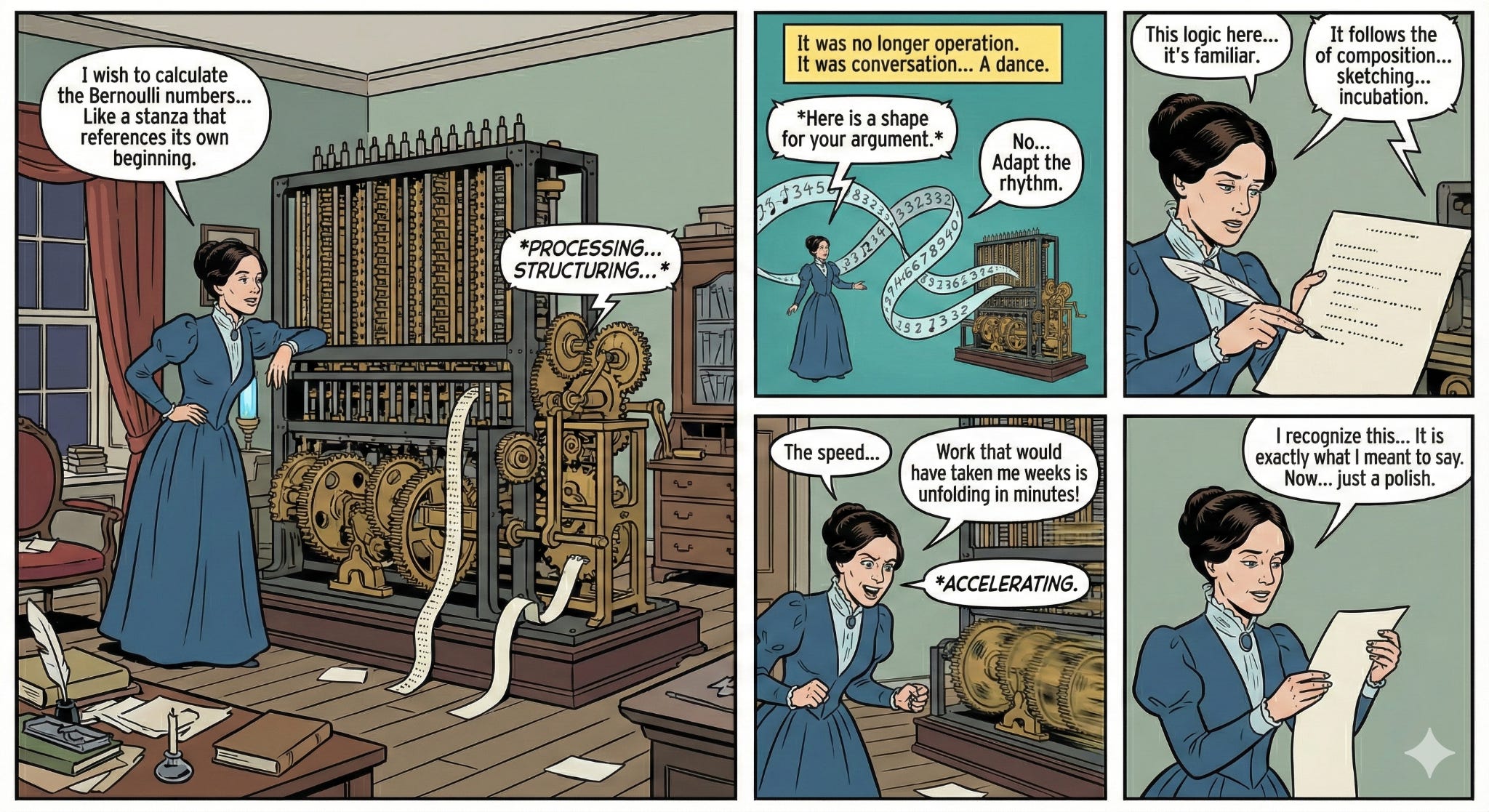
What surprised me wasn’t the making the code. It was how familiar the rhythm felt.
Any writer knows there’s a time for sketching – fragments, possibilities, half-thoughts. A time for playing with structure. A time for planning. Then production, when you finally commit words to the page. And after that, the editing: reading what you made with colder eyes.
Building with AI followed the same phases. But what mattered most was the part before building began – the brief, the incubation, getting clear on what I actually wanted before asking for anything. That preparatory work, the upstream work, turned out to be where the real thinking happened.
And then: the speed.
What would have taken weeks – or never happened at all, because I’d have given up – unfolded in hours. The construction whirred past. Code appeared that I couldn’t have written but somehow understood. I’d stand back, look at what had been made, and recognise it. That’s what I meant. That’s the thing I was trying to describe.
Then came the polishing, easy and almost playful. A tweak here, a refinement there. The same editorial instinct I’d use on a paragraph, applied to something that actually worked.
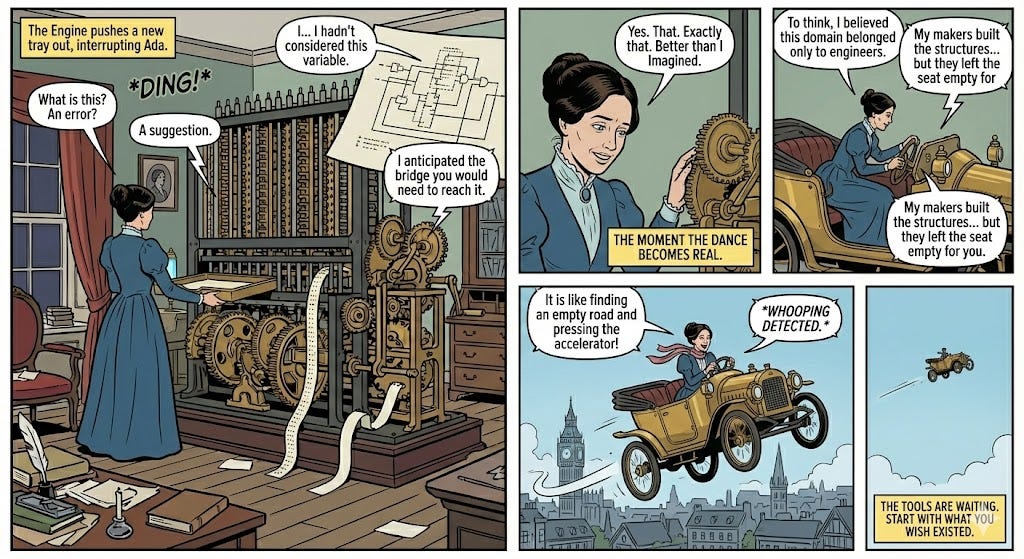
But the strangest part was when the machine pushed back – not with errors, but with suggestions. Things I hadn’t considered. Possibilities I wouldn’t have reached on my own. And instead of resistance, I felt recognition. Yes. That. Exactly that. The thing I wanted, made better than I’d imagined it.
That’s the moment the dance becomes real – when your partner anticipates a move you didn’t know you needed, and you follow.
Why this matters for all of us
If you’ve ever stared at a command line and felt it wasn’t meant for you, I understand. I felt it too.
But here’s what I’ve learnt: the hardest work is still important, but it doesn’t have to be so hard. Not easy. Not automatic. But possible in ways it wasn’t before.
These tools come from a cousin profession. Coders and engineers built the structures that make this process of creation work – version control, modular thinking, systems that remember and adapt. Those tools are sitting there, waiting. Ready to carry you towards creative work you’ve craved but might never have reached unaided.
I wrote this piece in a fever of ideas, then shaped it in a dance with Claude. My voice became our voice. Nothing was lost. Much was gained.
A thought partner, as Ethan Mollick calls generative AI systems, is more than a spellcheck. It’s more than a researcher. Thought partner work is what happens when you stop working at a machine and start working with one.
This is as liberating as climbing into a sports car, finding an empty road, pressing the accelerator – and whooping at what you’ve become.
If you want to try: start with something you wish existed. Describe it in plain language. Ask the machine to help. Then push back, refine, and follow where it leads. If Claude Code sounds complex remember that not long ago ChatGPT seemed incredibly complex.
I’m going to write more about The Helix app, and the ideas behind it soon – it’s very much the focus of the work. But it was the making, and the feeling of the making, that I wanted to share today. This is all what they call vibe coding, but it’s about much more than creating software – or perhaps making software is about much more than most of us think.
Thank you for reading.
Antony