
The Big Blindspot
Why some companies don't see the forest until the trees die


I. Self-checkout stupidity
Here’s a short clip of Rory Sutherland properly ranting.
In it he calls McKinsey “running dog lackeys”, but there are other good reasons to watch it.
He’s talking about the way that management (and management consultants) are incentivised to produce savings in small parts of systems while ignoring (and not being accountable) for the consequences in the wider system. He uses the example of automated supermarket checkouts.
And those are the same people who imposed self-checkout on supermarkets, probably got a nice bonus because they’d reduced the headcount of the supermarket. Six months later, there’s a massive epidemic of shoplifting, because it turns out nobody feels that bad nicking from a machine, okay?
Systems work because there is slack in them, he says, and if you optimise the parts you make the whole brittle, prone to failures.What he says is:
...we’ve created businesses where we’ve siloed them into lots of people who are optimising the parts, and meanwhile, the whole is turning to shit.
Quite.
The good news: a new technology (AI) has come along that can help us understand systems better, coordinate efforts throughout them, and think more broadly.
But we’re using it mainly, of course, to optimise the parts.
Worse, in looking at the possibilities and implications we seem unable to discuss anything other than issues focused on the fate of those parts.
Parts like jobs – and we’re describing all the immediate and possible effects of the technology in terms of them.
If you remove friction from one part of a system it moves to another (or creates friction elsewhere. It’s why productivity is hard to see when one team gets a boost from AI (if a developer team can produce 100X more code, there’s still the same number of legal and compliance people trying to check it and the same number of sales and marketing people trying to get it out there who aren’t using AI yet).
In the supermarket the labour of the checkout person moved to the customer and, in Sutherland’s account, it changed some customers’ perceptions of the contract and possibilities of the relationship. (I imagine there are other reasons that shoplifting has spiked: the economic catastrophe of Brexit, rising energy prices, the pandemic and their culminating in a cost-of-living crisis (media-speak for people finding it hard to afford to eat). But these are matters for other articles.)
Systems are hard for us to understand. We like simpler things. Things we can name and count.
Organsiations where systems are understood, acknowledged and translated into plans, cohesive policies and job descriptions are rare (maybe Airbus, Toyota). We deal with what is in front of us, make the best decisions we can and try to get by organising the parts in front of us.
II. AI vs jobs is a dumb question
Which is why “Which jobs will AI replace?” is a less important question than we think. Compared to the real issues and in light of what we know, I’d go so far as to call it a dumb question.
Jobs! A dumb question?
The reaction to someone saying something like that in public is emotional, often personal and irrational.
But humans are emotional decision-makers, socially networked emotional beings whose survival instincts give them a dread fear of being expelled from a group. So that first roar of outrage at the question will anchor the mood and take the room with them.
Humans have also developed techniques to disrupt those emotional patterns. In different contexts, scientific method, mindfulness, and critical thinking give us a way of slowing down our thinking and looking at what’s happening. Creating a gap between stimulus (outrageous statement) and response (shout them down).
When it comes to AI and jobs, I saw a live demonstration last week of how difficult it is to do that, but also the will to keep trying to think it through.
I was at the Baduel Brief, a strategic communications “salon”. 40 or 50 people from academia, politics, media, industry and the PR sector. During the speech and the beginning of a panel discussion the tenor was thoughtful and intelligent. At first.
The dilemma of fast and slow thinking about the topic of AI was framed perfectly with Elif Güvençer’s account of her “Two Clocks” framework.
There are two clocks running simultaneously. Most Communications functions manage only the immediate one.
The immediate clock is outward-facing. It runs the operational demands that monitoring, content creation, and reputation management now carry in an AI-mediated world. Reputation is now mediated by synthetic intermediaries that compress an organisation into a paragraph and hand it to anyone who asks. Governance now extends to systems Communications has never had to engage with before. All of it is legitimate, all of it is urgent, and all of it will absorb every hour the function has — including the hours AI gives back by automating tasks.
The structural clock is inward-facing. It determines what Communications needs to become to meet the needs of the AI era — and it gets no such urgency. Nobody is asking the CCO to audit whether the function is being valued for what it produces or for what decisions it influences. Nobody is scheduling a board conversation about what Communications needs to become. That work has no external deadline. Nothing forces it onto the calendar. It will not happen unless someone makes it happen.
I don’t think it is just about communications. (Although there is a specific urgency for that profession we’ll get into another time.)
We’re all reacting to what’s in front of us.
III. Look at the evidence and carry on shouting
That evening’s debate demonstrated the drift. We started high – frameworks, structural clocks, two kinds of time – and drifted gently towards dinner-party received wisdom. By the end, clever and accomplished people were arguing that their children would be better off training as blacksmiths than studying maths. Flaubert would have found a new entry for his Dictionary of Received Ideas.
(An aside on method: prefacing a story with “I know this is only anecdotal data” does not upgrade the story. It is the evidential equivalent of “no offence, but”. You know exactly what is coming, and it is not data.)
The panel were critical of the Frontier Labs’ irresponsible handling of the narrative about AI – their message: “this is going to destroy jobs and disrupt society” did nothing to frame a useful debate and just had everyone worrying about which jobs would go and when.
“Which jobs will AI replace?” is Big Tech’s framing, delivered with the confidence of people who build models, not organisations. The people most certain about which jobs will disappear are the people selling the technology, which tells you a lot about confidence and almost nothing about the jobs.
So what does the evidence actually say? Awkwardly for everyone with a strong opinion: it points both ways at once. This can mean “we don’t know” – cue returning to entrenched positions – or a clue that we are asking the wrong question.
The fear has data behind it. A Harvard study of the résumé histories of 65 million workers across more than 280,000 US firms found that after adopting generative AI, firms sharply slowed their hiring of junior staff while senior employment carried on much as before. The bottom rungs of the career ladder are being quietly sawn off – mostly not through firings, but through roles that simply never get advertised.
The comfort has data too. PwC’s 2026 Global AI Jobs Barometer, built on more than a billion job ads, found that the companies most exposed to AI grew headcount faster than the least exposed – 52% against 36% – with higher productivity growth and a 62% wage premium for workers with AI skills. The firms investing most heavily in AI are hiring more people, not fewer.
This week another study appeared to back that “more AI, more jobs” line. Actually it was at pains to point out the limits of its data. Clara Murray in the FT reported on study by Ramp (a US payments company) and Revelio (a workforce data company) which seemed to show that firms that spent more on AI also hired more people.
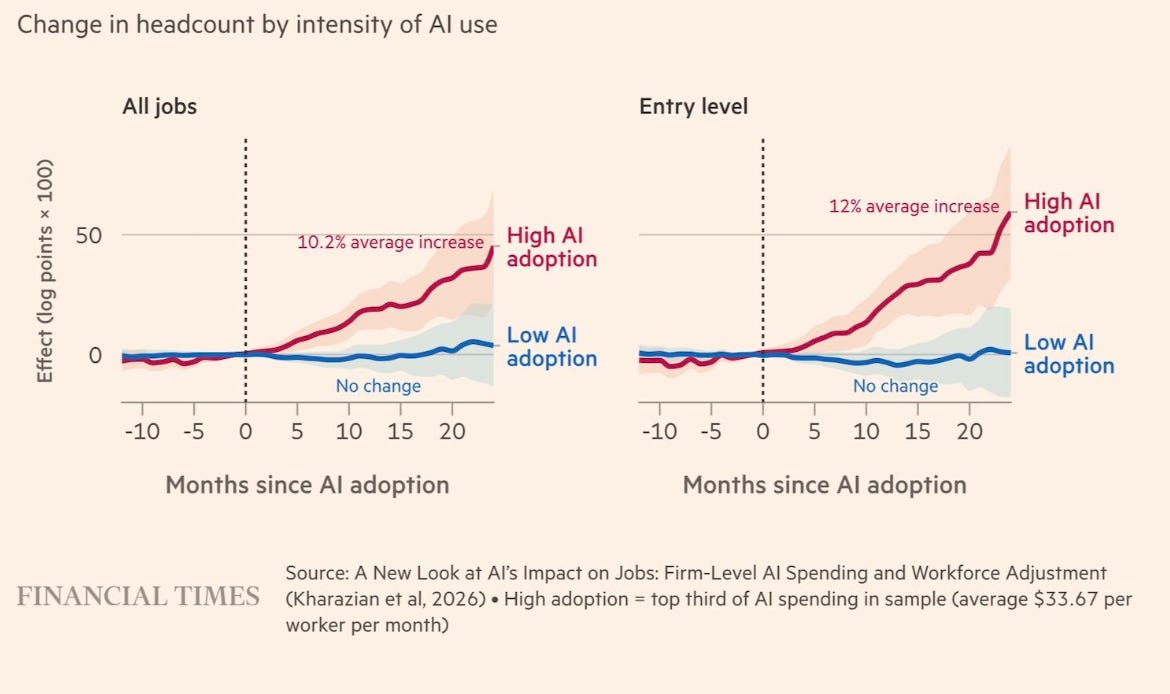
Does the PWC study cancel the Harvard one? No. Should it stop the person mid-shout at the dinner party? Also no, probably – but it might make them pause, and the pause is better than letting them just roll on. Counter-evidence like this rarely settles an argument, but it can interrupt unhelpful certainties for long enough that thinking can restart.
Because both findings can be true at once, and probably are. Junior hiring falls while total headcount rises. The ladder breaks while the building grows. Headline employment numbers – the endpoints – can look reassuring even as the structure underneath them is being rewired.
And that is the real trouble with “Which jobs will AI replace?”. Jobs are endpoints. They are what you can see in a static picture of an organisation: a headcount, a job description, a box on the chart. What you cannot see in the picture is everything that happens between the boxes – handoffs, translations, permissions, trust, waiting. Jobs are visible; coordination is not, as Choudhary puts it in his excellent book Reshuffle.
AI is changing coordination before it changes employment. Which means the people staring hardest at the job numbers are watching the wrong instrument.
IV. Seeing like a manager

Caption: Can’t see the forest until the trees die. Die-back in a Bavarian forest in 2011 (Source (cc) High Contrast)

Why can’t we see the rewiring? Because organisations are built to see other things.
In 1998 the political scientist James C. Scott published Seeing Like a State, a book about why grand schemes to improve the human condition keep failing. His argument starts with a simple observation: to govern something, you first have to see it. To see things states simplify (because the closer you get to reality the more complex it is). Standardised surnames, cadastral maps, grid-plan cities, forests replanted in neat rows of a single species. Scott called this quality “legibility” – the world redrawn so it can be counted, taxed and administered. Managed, even.
The catch is what the redrawing leaves out. His opening example is Prussian scientific forestry in the 18th and 19th century: underbrush cleared, deadwood removed, one commercially useful species planted in tidy rows. The first harvest was magnificent. The second was a disaster the Germans had to coin a word for – Waldsterben, forest death. The map had deleted everything the trees needed to be a forest: the fungi, the insects, the mess. The “illegible” parts turned out to be the forest, not the trees.
Management sees like a state. Its instruments measure headcount, budgets and outputs – the legible organisation, the one that fits in a spreadsheet. But a great deal of what makes an organisation actually work never appears on any instrument: the quality of handoffs, the colleague who translates between finance and engineering, the trust that lets people skip three approval steps, the waiting that quietly absorbs a third of every project. Value lives in the connections; measurement lives in the nodes. Call it coordination blindness.
Think of Rory Sutherland’s supermarket. The checkout staff’s jobs were legible – a line on the payroll, easy to optimise away. What went with them was illegible: the ambient supervision, the small social contract at the till. Nobody got a bonus for maintaining that, because nobody could see it.
It also explains why “Which jobs will AI replace?” feels so natural to ask. Jobs are the most legible objects in an organisation, in the lives of the people who work there. Of course we reach for them. We are counting the trees in rows while the forest’s ecosystem is about to completely change.
As Güvençcer explains, the WEF is one of many organisations that has published data and league tables of which jobs and sectors are most “exposed” to AI. These are headline grabbing, attention grabbing (where’s my job, where’s my children’s possible careers?) when they measure nothing useful at all. Dumb data pushed out to fuel dumb questions about jobs. Which trees should we plant in rows? How can we get rid of all these pesky weeds and fungi that clutter our otherwise productive forest up?
V. Revolutions arrive in relationships
History’s advice on new technology is consistent: don’t stare at the thing. Watch what happens to the relationships between things. The big changes are in connections – where new ones are formed and how things flow through them.
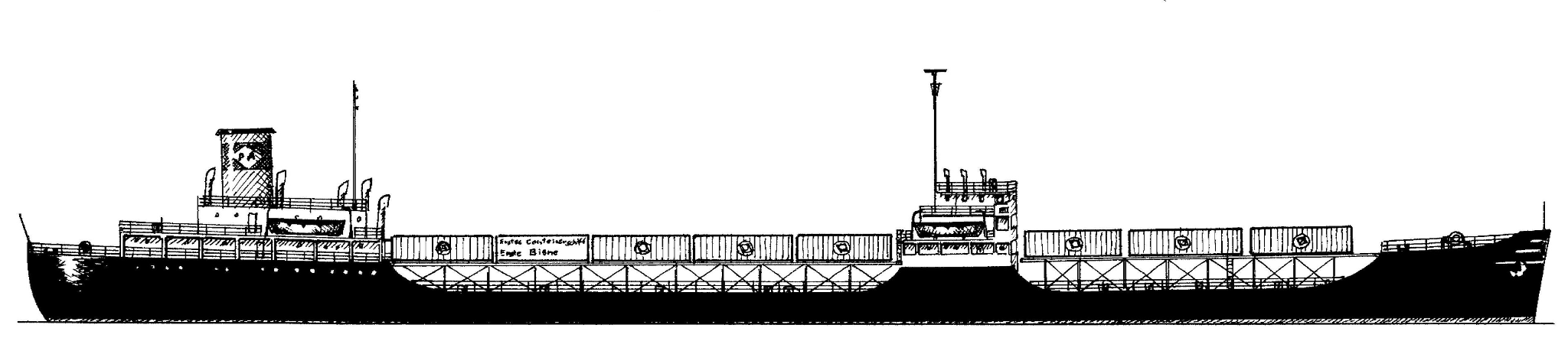
Caption: (cc) Kartsen Kunibert - Plan of the The SS Ideal X, the first container ship.

In April 1956 a refitted oil tanker called the Ideal X carried fifty-eight metal boxes from Newark to Houston. The shipping container is about as boring as technology gets – a steel rectangle, no moving parts. Anyone assessing it as a thing would have concluded, reasonably, that dockers would lose work and freight would get a bit cheaper.
What it actually did, as Marc Levinson tells it in The Box, was rewire the relationships: between ports and their cities (New York, Liverpool and London gutted; Oakland, Rotterdam and eventually Shenzhen made into global hubs), between factories and customers (once shipping cost almost nothing, they no longer needed to be near each other), between labour and capital. The box made Asia the world’s workshop. Nobody watching the Ideal X leave Newark was predicting that.
Generative AI’s headline act is generating things: emails, images, code, sixth-form essays about the Weimar Republic. Its structural act is less legible, less visible. It collapses the cost of moving context between people – briefing, summarising, translating between specialisms, waiting for the one person who holds the background in their head. Every organisation pays a tax on every handoff, and it has been rising for decades as work became more specialised.
VI. The productivity puzzle, again
In 1987 the economist Robert Solow made his famous observation: “You can see the computer age everywhere but in the productivity statistics.” Three years later Paul David explained why, in a paper called “The Dynamo and the Computer”. Factories, he showed, took roughly forty years to get the benefit of electricity.
The first thing manufacturers did with the electric motor was bolt it into the spot where the steam engine used to be, driving the same overhead shafts and belts that had shaped the factory around a single power source. The gains only arrived when a new generation redesigned the whole building – distributed motors, single-storey layouts, workflow arranged around the work instead of the drive shaft. The technology was fast; the rewiring was slow.
Substitute “AI pilot” for “electric motor” and you have a fair description of most organisations in 2026. Gallup’s latest workforce data makes the gap almost comically precise: 65% of employees in AI-adopting organisations say the technology has improved their own productivity, while roughly one in ten strongly agree it has transformed how work gets done across their organisation. Individuals are electrified. The organisations around them are still built around the steam shaft.
Look at what AI actually removes and the gap makes sense. The hours it gives back come mostly from the friction around work – the briefing, the summarising, the waiting for the person who knows, the meeting to align on the meeting. That friction was never on the org chart, so when it shrinks, nothing on the org chart registers. The individual feels faster. The instruments read no change. Coordination blindness again, this time hiding the good news.
VII. Bottlenecks migrate
There is a second reason the gains go missing, and a factory novel from 1984 explains it. Eliyahu Goldratt’s The Goal – the only management book I know with a plot – gave us the Theory of Constraints: every system has one binding constraint, and improvement anywhere else is an illusion. An hour saved at a non-bottleneck is a mirage. The machines upstream just pile up inventory faster.
The corollary matters more: fix the constraint and it doesn’t disappear, it moves. Make drafting instant and approval becomes the queue. Make analysis instant and decision-making becomes the queue. Make research instant and the constraint migrates to the one thing AI cannot yet compress – the humans who must agree with each other before anything happens. Plenty of organisations are discovering this now: reports written in minutes, then a three-week wait for the meeting about them.
This is why “AI transformation” fails as a technology project and only works as a systems project. Deploying the tools is the easy, legible bit. The value depends on chasing the bottleneck as it moves – and the bottleneck does not care about departmental boundaries, budget lines or whose transformation programme it wanders into.
VIII. The leadership shift
Follow the argument this far and the job description changes. For most of the last century, running an organisation meant optimising fixed structures: set the departments, set the targets, tighten each part. That is the machine Rory Sutherland was mocking – everyone optimising their silo while the whole turns to shit.
But if the structure itself is being rewired – if the cost of moving context is collapsing and the bottlenecks are on the move – then optimising the current structure is polishing a map of a country that no longer exists. The work shifts from optimising departments to designing flow: noticing where work waits, where context gets recreated, where the constraint has migrated this quarter, and redrawing the connections accordingly. Less chief operator of the machine, more architect of coordination.
That is the real leadership consequence of AI, and it has almost nothing to do with headcount. The leaders who navigate this well will be the ones who can sense the rewiring while it is happening – which, conveniently, is a thing that can be practised. That is where we go next.
I’m going to return to Elif Güvençer one more time to conclude this piece:
“AI is not a productivity layer […]. It is a structural stress test.”
That.
Fantastic post!
Hugely enjoyed this, thank you