

The Bloom boom edition
How we can loop our way to higher order thinking.

Dear Reader
In one of those strange quirks of fate, I’m going do some work in Estonia this week, a place I’ve been writing a lot about recently because of an inspiring talk I heard from the country’s education and research minister back in January. Her ideas and the inspired strategy that her team have developed and are now implementing, have not only stuck in my mind but begun to shape how I see the knowledge work and thinking evolving in the next few years.
But first…
I tried some new thoughts about loops and agents out with the wonderful Brighton AI group earlier this week. The video is here and there’s a write up over on BN Edition too – “Agents are Loops”.
There’s something very energising about preparing for talks like these. They are shorter (15 minutes), there’s a huge amount of uncertainty – the brief was “something interesting”, and the audience ranges from computer scientists to entrepreneurs and people just starting out in their career – so you end up just trying to talk about things you’re finding interesting right now and that might be worth sharing.
What this one let me do was spend much of an afternoon trying to articulate why the idea of loops is so exciting to me right now. Here’s an excerpt from the BN article:
…every time something annoys me, I treat the irritation as a flag. That thing that just wound me up is almost never a one-off task. It’s a process that nobody has written down yet. And if it’s a process, it can probably be a skill.
A skill, in the sense I mean it, is just a plain-language file that explains to an AI exactly how to do something. If you’ve prompted your way to a good result, you can now convey that process to most AI tools.
Which thoughts do you get handled, and which stay in your hands?
Back to loops: my new rule is that, unless I can make something a loop I’m not doing it. The longer version of this is a mantra:
If it’s a task, it should be a process. If it’s a process, it should be a skill. If it’s a skill, it should be a loop. And sometimes it should become an agent.
There is an agent that reads my inboxes at six every morning and leaves a briefing in Slack before I’m properly awake. It started life as a task – something I did blearily, with coffee. Then a process: the same steps in the same order every day. Then a skill: the steps written down where the machine could read them. Now it’s a loop that runs without me. I have delegated a small piece of my morning self.
What’s actually going on here is older than the technology. A tool is a thought that’s been given a handle. A checklist is a thought that doesn’t trust you to remember it. A good workshop is a mind turned inside out – every decision about where things go was made once, by someone thinking hard, so it never has to be made again.
We’re used to treating thought as weightless: it happens in the head, in private, and it’s gone by lunchtime. But thought can be given mass. Write it down and it persists. Build it into a tool and it acts. Put it on a schedule and it has momentum – it keeps moving after you’ve stopped pushing. Lately the trade runs both ways: my notes used to just sit there, remembering; now systems read them and act. Memory, given thought.
But not everything should become an agent. Writing this newsletter is a task, and a process, and I suppose you could call it a skill. It will never be a loop.
So the cool thing isn’t really automation, it’s deciding what to keep. Which thoughts do you get handled, and which stay in your hands?
Bloom’s leap
In thinking about thinking – what to keep literally in mind, and what to put into the systems – I’ve been intrigued and inspired with a 70 year old model for how people learn: Bloom’s taxonomy.
In 1956, Benjamin Bloom, a University of Chicago professor, and a committee of college examiners published a taxonomy of educational objectives. They were trying to solve a dull administrative problem: exam boards at different universities couldn’t agree on what they were testing. The answer they produced outlived the problem and shaped how even the most advanced, AI-era school curriculums are planned today.
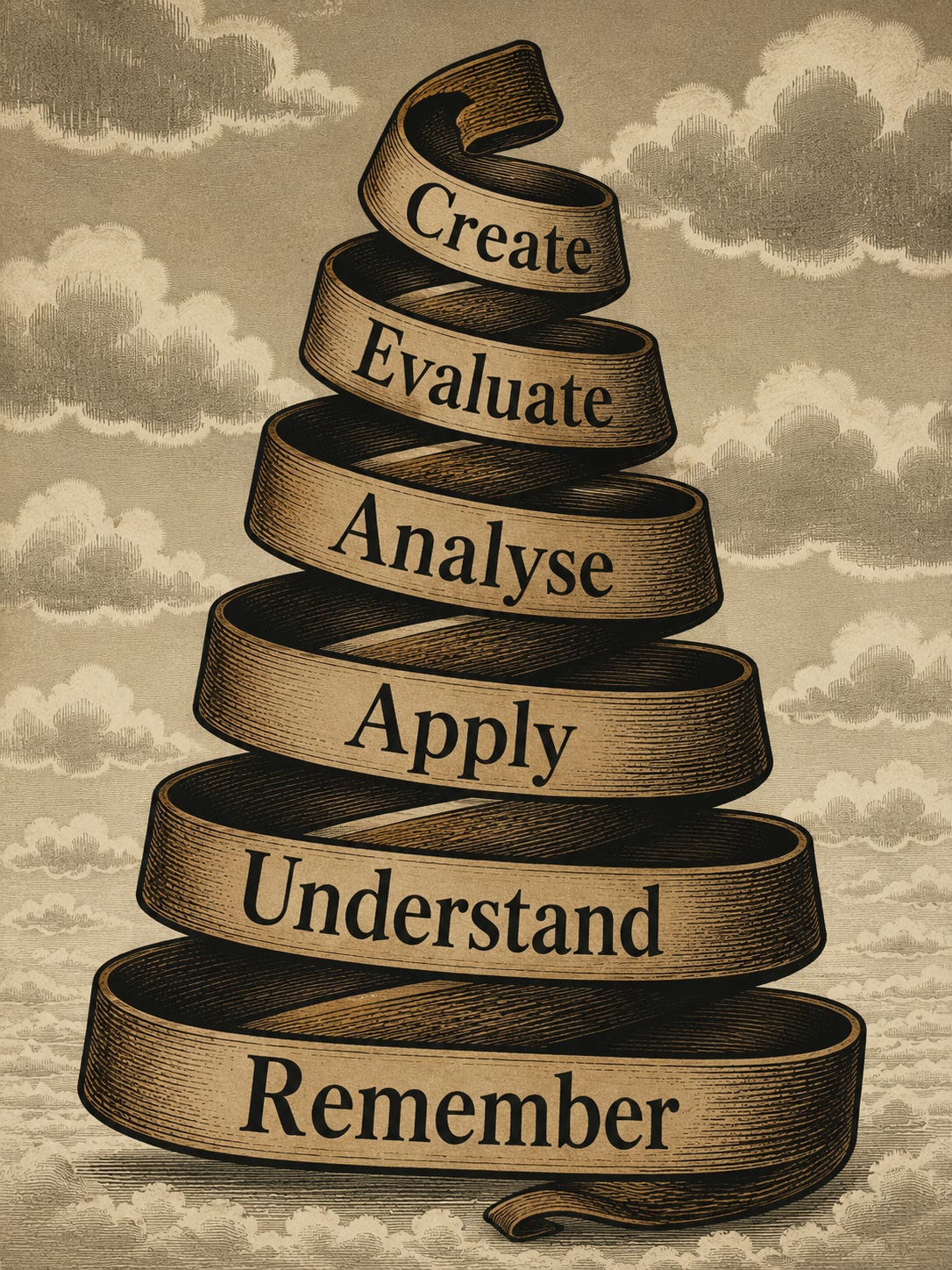
Bloom’s taxonomy is usually drawn as a pyramid. At the bottom: remembering. Then understanding. Then applying. Then – and the air gets thinner here – analysing, evaluating, creating.
Analyse: You can apply knowledge or a skill but also disassemble it like a soldier field-stripping a rifle. You know how it works, intricately.
Evaluate: You can see the thing in parts or a whole and understand how well it is doing its job – whether a new part here would improve it, or its strengths as a whole vs alternatives.
Create: You can create new versions of the thing – the skill or the output. Bloom’s create level sounds like a good proxy for mastery.
The bottom three are what some call lower-order thinking and learning skills. The top three are higher-order.
Most of modern education lives in the bottom half. Most of most jobs do too. Remember the regulation, understand the brief, apply the template. In college, university or in apprenticeship the deeper understanding and ability to innovate and invent begin to come through. The first decade of a professional career is, in Bloom’s terms, an apprenticeship in the lower layers of a domain. Although not always, and – because: AI – maybe not for much longer.
And the lower layers are exactly what large language models do.
Not perfectly – they misremember with great confidence, which is its own genre of problem. But remembering, summarising, applying a known pattern to a new instance: that’s the machine’s home territory now. Bloom’s pyramid hasn’t fallen over because AI arrived, but perhaps it is being flooded from the bottom.
So the value of human thinking is migrating upward, layer by layer, whether or not anyone planned for it. Who has noticed? And what are they doing about it?
Estonia’s education ministry started asking those questions two years ago.
I’ve pointed at Estonia in these pages before, and at Brilliant Noise we’ve used it as the counterexample to a hundred corporate AI programmes that died in the pilot phase. But it’s worth being specific about what they actually did, because the specifics are the point.
Estonia has 1.4 million people and no margin for complacency – a small country next to a large, hostile one tends to think hard about what its children will need to thrive in the economy of a state that will need to strive to harden its existence. In 1996, its government launched Tiger Leap, which put computers and an internet connection into every school in the country, at a time when most education ministries were still debating whether the web was a fad. A generation later, Estonian fifteen-year-olds top the European PISA rankings – the OECD’s three-yearly worldwide tests of reading, maths and science at fifteen.
When generative AI arrived, they ran the same play. The programme is called AI Leap – the name is a deliberate echo. From September 2025 it puts AI tools and training in front of tens of thousands of secondary students and thousands of teachers. But the tools are the least interesting part. The interesting part is the question the Estonians asked first. Not “should we do something about AI?” – the question that has paralysed most Western institutions – but “what specifically should children learn to win in a world where AI exists?”
Their answer was the top of Bloom’s pyramid: analysis, evaluation, creation. Teach children to interrogate what the machine produces, judge whether it’s any good, and make something the machine couldn’t. Leave the flooded layers mostly to the machines.
A national curriculum, rebuilt around higher-order thinking, by a country that has done this before and has the test scores to show for it. That’s a decision.
(Watch the Estonian education minister give a 15 minute talk about their curriculum here.)
Bloom’s pyramid isn’t a diagram of what thinking is worth, it’s a diagram of how thinking – thinking skills – are built. You climb it from the bottom. The junior lawyer reading a thousand tedious contracts is doing “remember” and “apply” – and somewhere in the boredom, judgement is forming. The medical student memorising anatomy is laying down the foundational facts that diagnosis will later stand on. Nobody has ever become a good evaluator of work they’ve never done.
If machines make the bottom layers easier – or make them easier to be sure of – where do the steps up the pyramid take us?
Here’s Kristina Kallas, Estonia’s education and research minister, explaining the point:
Our brain operates in two distinct modes: lower cognitive modes and higher cognitive modes.
The lower cognitive mode revolves around remembering facts, memorizing information, understanding it, and then applying it. Once you learn something in this mode, you use it repeatedly without rethinking it. A perfect example is learning to ride a bike – you don’t relearn how to balance every time you get on a bicycle, you simply rely on that stored knowledge. For the past 200 years, our education system has been built almost entirely on this cycle of memorizing, understanding, and applying.
The problem today is that rapidly evolving technology and a changing world are forcing us to shift. Because our reality changes so quickly, we can no longer rely on automatic, static knowledge. While prior learning is helpful, we now must constantly learn, unlearn, and relearn. This continuous learning process requires our higher-order cognitive skills. You have to constantly analyze new situations dynamically rather than relying on old habits, evaluate the best course of action for unprecedented scenarios, and create new knowledge and capacities to operate effectively in a changing environment.
Historically, schools have not been particularly good at fostering these higher-order thinking skills, but the rise of artificial intelligence is forcing our hand. We can no longer graduate students with only lower cognitive skills. Sending a child out into the world knowing only their multiplication tables is no longer enough because computers can calculate instantly. To be clear, foundational skills like multiplication are still necessary to learn, but they are no longer the finish line. Education must evolve to prioritize the higher-order creative and analytical thinking that machines cannot replicate.
Estonia’s bet is that you can teach the top half of the taxonomy more directly – that analysis and evaluation can be trained as skills in themselves, with AI handling the scaffolding underneath. It’s a serious bet, made by serious people, and I hope they’re right.
Nobody knows, yet. There is no longitudinal data on what happens to judgement when you remove the drudgery it used to grow from, because the experiment has only just started. Despite the breathless misreading of selective academic papers, we don’t have reliable evidence of “brain rot” or “cognitive debt” (or all the other neological ailments that are invented to accompany any new information technology - some may be valid, but they are not accepted pathologies). The first cohort of Estonian AI Leap students won’t hit the workforce until the 2030s. Anyone who tells you they know how this ends is selling something.
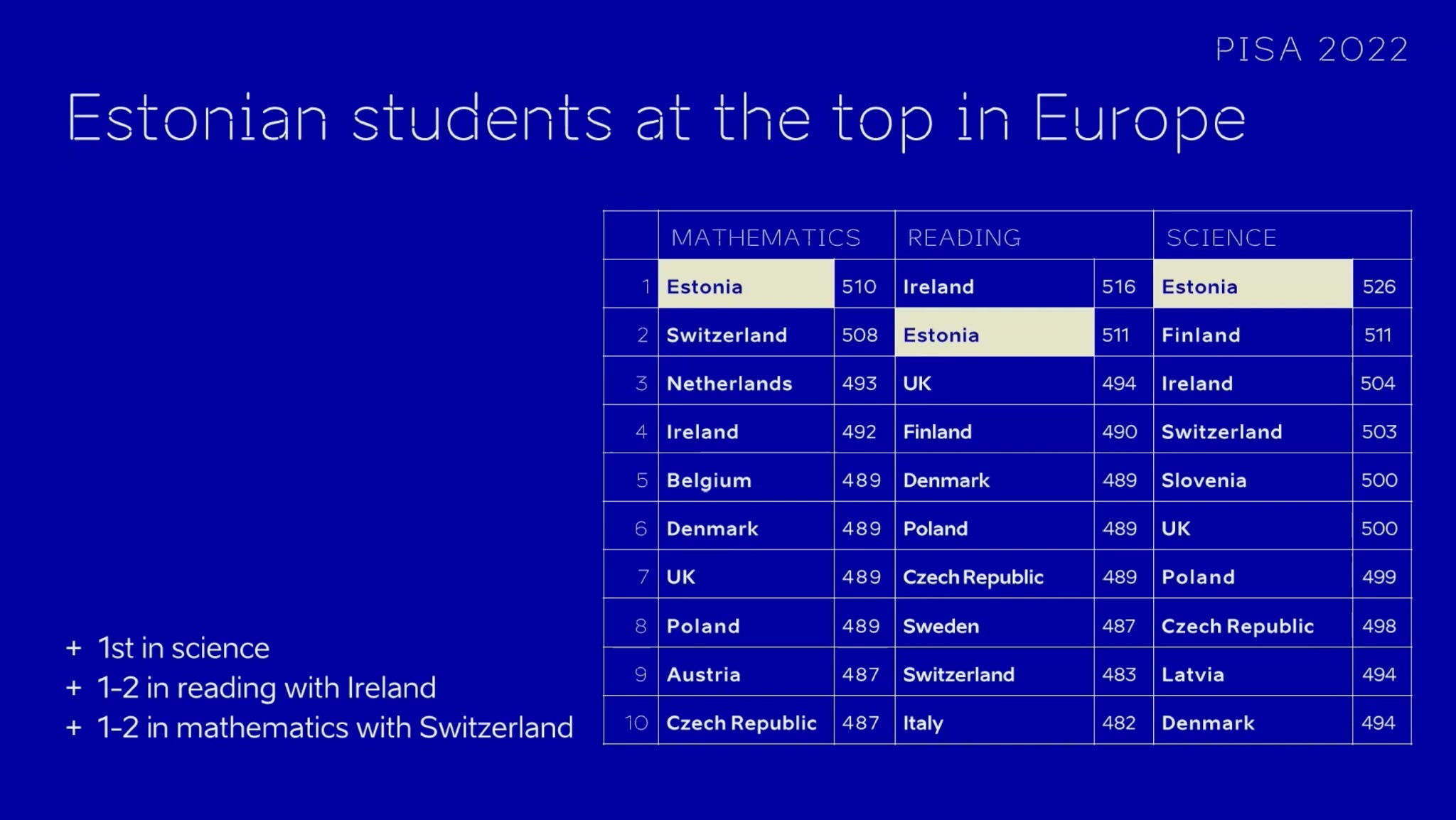
We do know that when Estonia produced its digital curriculum in the 90s, critics predicted that the kids would all be playing Tetris and surfing the web and would therefore be semi-literate imbeciles by the time they left school. They were right, the Estonian education minister said – they did spend lots of time playing online games and looking at websites. They also turned out to be the most successful cohort of professionals and entrepreneurs the country ever produced, outperforming superpowers and competitors in a whole load of education and financial benchmarks.
Estonia has started. Some companies have started to seriously reimagine the way they work. Most are still frozen, hearts thumping, deciding whether it’s safe to approach.
What would you teach a child to do that the machine in front of you can’t? What would you decide to learn with your team?
Thank you for reading.
Antony
One more thing: PR in the real world
In case you haven’t had enough of my voice, Viva PR’s PR in the Real World ran an episode interviewing me this week, that we recorded a month or so back. I left the PR profession about 20 years ago, but it never really left me. Especially as AI has become our focus at Brilliant Noise, we have found ourselves working with agencies, in-house leaders and teams, around the world.
Interesting and enjoyable. Thanks Antony
Totally with you re: Estonia - have long admired their whole approach to digitalisation