
Which hunt?
What are we on alert for? What’s at stake, and who are we burning at it this week?

Our brains are energy misers. Mostly.
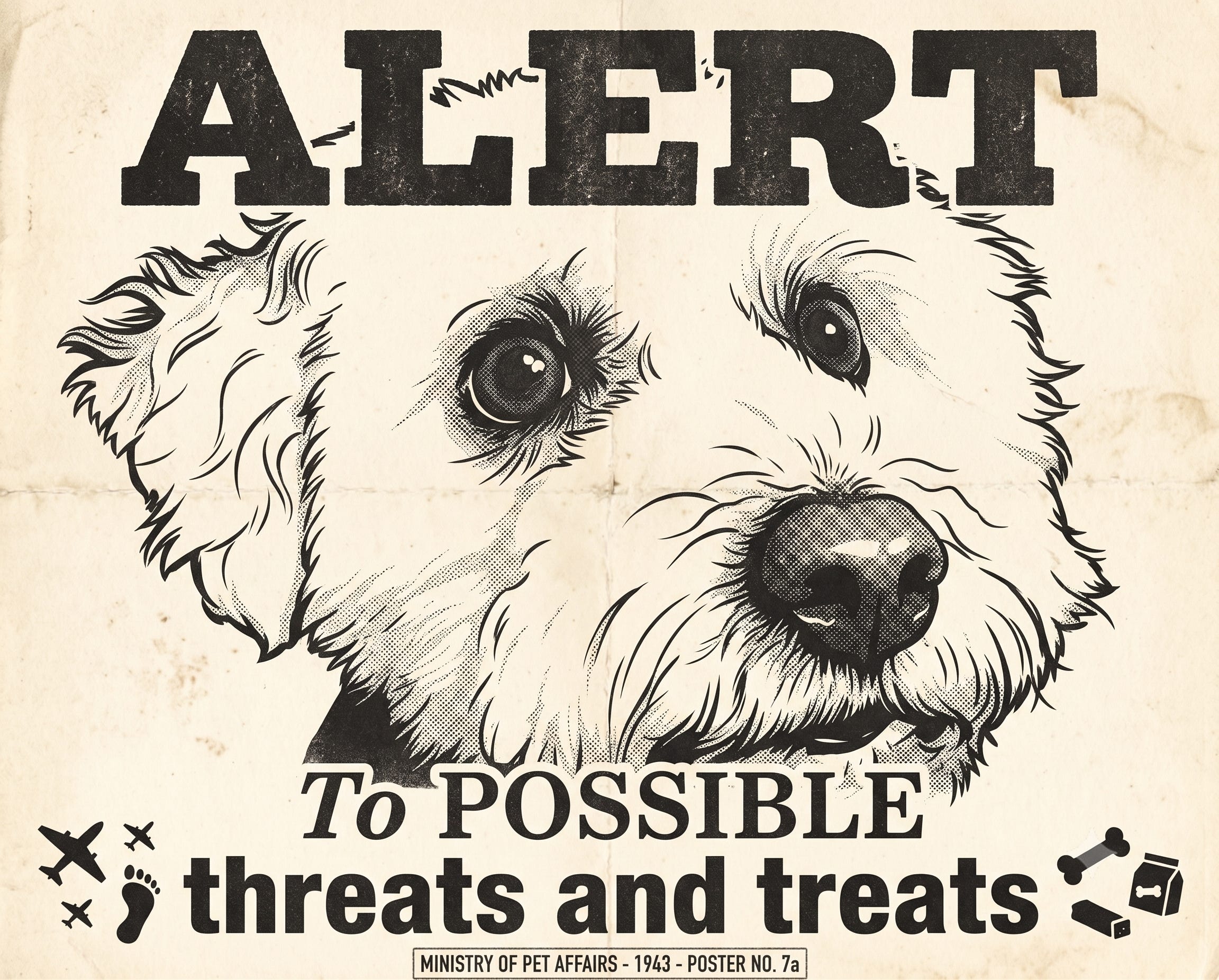
They are like my Bichon, Sybil. She sleeps most of the time but stays alert for signs of two things: treats and intruders. Or, to be precise, to the possibility of treats and intruders.
The treat triggers are the hour at which breakfast and dinner usually arrive, and people doing certain things, including preparing or eating food, opening the fridge, setting grocery bags down on the floor. Each of these developments is met first with ears pricking up, then a move towards the place where treats might happen, then deep attention on all activity. Sometimes she offers an encouraging, plaintive noise to indicate her presence.
Intruders happen far less often than treats, but the possibility of one is constant. Cats on the back wall, visible from both of the chairs she prefers to sleep on. Anyone approaching the door. Dogs barking in the street. Foxes, sudden noises, applause, me shouting at the television. All qualify as reasons to stop sleeping and go to high alert.
Her anti-intruder tactic – far more effective, to her mind, than her treat-encouragement tactics – is to bark a lot. This annoys her human companions, but if Sybil could speak she would point out that the rapid, continuous assault of barking has a 100% success rate. In the nine years she has been on duty, 99.999% of intruders have been deterred. Better than most security systems and most human guards, and more than justification for her modest retainer of room, board and a medical plan (admittedly more comprehensive than the ones enjoyed by her owners).
Like most dogs, and she would count herself better than most, Sybil looks lazy but is always poised for action in the service of her household.
Our brains work much the same way. They keep energy expenditure low, coasting on habit and routine, unless there is the possibility of significant reward or a threat to survival.
Signals of new knowledge
Leave the threat response aside and look at reward. Not just pleasure, but knowledge. Brains sit up and look around when they sense there is new knowledge in the area. Surprise triggers this fastest – anything that interrupts the well-trodden paths that habit guides us down. We are not always rewarded, and we are disappointed when we learn nothing. When we do find something new it feels great: all sorts of helpful hormones and chemicals in the blood, and we like the experience.
Often the signal for new knowledge is a few words. So when we write, we put things up front that say: new knowledge here, come and experience the fresh insights. We call them headlines, hooks, opening gambits. They vary between cultures, and they game the system a little.
On the newspaper where I trained, I learned to write with the story up front and the rest ordered in a pyramid – the story first to win the reader’s attention, compressed into the opening paragraph as a hedge against losing it.
Take the phrase “process over product”. At a software or marketing conference, seeing that on a slide, I would give it a one in four chance of being interesting. My unconscious prediction is that it is a catchy form of words, unlikely to be groundbreaking. If the speaker were Herminia Ibarra or Jony Ive it wouldn’t matter, because I would already be paying deep attention – I know they are likely to have developed ideas worth spending energy on.
The phrase was in an article I read this morning by Jeannette Winterson. She was writing about how tech companies seem more interested in the thing being made than in the making of it, and she repeats a story told to her by the composer Max Richter:
[…] he was invited along to DeepMind to talk about the process of composing. They played him bits of AI Beethoven, which he said was better than expected, for about 10 minutes, and then just more of the same. What interested him is how uninterested they were in the process of composing, seeing problems as things to be fixed, on the way to getting the finished product.
The hunt
Making something is strange and exciting. There is jeopardy – will this be in vain, will it come to anything – and there is reward for perseverance. Either you make something or you learn something.
The process is not neat, or mappable, or, frustratingly for the product-focused, repeatable. It can begin the same way and follow familiar paths for a while, but to be worth anything the writer or composer or artist has to stay open to surprise. You have to be willing to barrel down dead ends and feel like a fool when you find you have wandered off course. Or the opposite: to discover that the thing you set out to make was the dead end all along, and that you have been making something else entirely.
What separates makers from aspirants is that makers stick it out, finish the thing and put it out there.
These Antonym newsletters, like the books and blog posts and daily letters to my company before them, are compressed versions of that process. Sometimes they fail completely. The last two weeks have produced drafts that never made it to production – valuable defeats. They were hunts for something I failed to catch, though the sighting was encouragement in itself.
It matters that people who write, or make anything, think carefully about their relationship with these thinking machines: where they add to the process, where they take away from it, and what that does to the thing produced. The decisions are theirs. As is the decision whether something is worth reading or not.
The ducking tool
In part realise I am writing about – or around – Substack’s introduction of Pangram, an AI detector app as a built in, opt-out feature for readers. This is a product decision, a point of differentiation, dressed up as “what readers want”. I’m uncertain what to make of a platform so committed to free speech that Nazis are fine, but writing assisted by AI is an egregious breach of the sacred trust between humans that will be spotted – by an AI tool – and publicly accuse of a breach of humanity.
Commercial and acceptable use choices aside, AI detectors are and always have been deeply problematic. Pangram is the best of a bad bunch. AI writing detectors return false positives, penalise non-native speakers, offer false certainty and dispense injustice every day in education and at work. Imagine being accused of plagiarism, except you can’t disprove it because the evidence is “AI said you did it”.
Pangram is Substack’s ducking stool. I imagine people writing to avoid being red-lettered by the algorithm, while an anti-algorithm mob uses the unquestioned “evidence” of an algorithm to police how other people read and write. Substack says there are 1 million posts every week. Pangram says it has a 1 in 10,000 error rate (critics say it is far higher) - so a minimum 100 people get to be shamed-in-error every week.
I can see the trap even as I write this. Once I’ve finished writing I will put it into Substack’s editing tool and post it for your reading delight. But I will, by order of Substack have to make two decisions:
Do I opt-out (it’s the default) from the public shaming feature? I’m guessing I will get a Green rating of 100% human, but who knows if I will be one of the unlucky 100 writers who get false positive.
Do I obey the suggestion to write a policy for potential readers
On both counts, I am tempted to comply. After all, I have nothing to hide… and I’m immediately nauseous at the thought of it.
This is nothing to do with whether I think people are breaking my trust when they get me to read their machine-milled prose, it has to do with dictats and being pushed around. As soon as you tell me I have to do something, I don’t want to. It’s a reflex, an involuntary twitch I get, my ears pricking up alive to the possibly intruder, of puritans and prose police coming round to tell me what is good and bad.
And I’ve decided. The only way I know how - by writing it out.
I’m not going to do what they tell me. Not in the mood.
Goss-OS
It may not feel like it, but all of this in-group/out-group game is, on an instinctive, emotional level, about survival. Just as Sybil treats a squirrel in the tree outside our back window as the possible signal of a life-threatening intrusion, our brains bet precious energy reserves on new knowledge because it might help us, or our families, survive.
That’s why there’s so much emotion involved. Why it feels dangerous to take a stand, and guiltily comforting to slip in with what looks like the crowd’s opinion.
This is why gossip, the most common use we make of language (observed to be c.65% of conversation), is about survival. It is the mechanism by which a group checks that its members are acting in the interests of the whole rather than themselves. Behave against the group’s interest and you face exile, and for most of our species’ history rejection by the group was a threat to life. Few would last long alone.
Gossip is what runs the human group operating system – call it Goss-OS. Our massive unique feature as a species is language – it scales possible group size from about 30 (chimps) to 150. When you start writing things down it scales thousands, and when you can publish on a magic network of screens that everyone can see, billions. It stops being feasible to throw people out of a group of billions, but we try anyway – still got the instinct. And if it feels like we might be thrown out of a group it feels like the end of the world. That’s why we get in-groups and out-groups, alliances and conflicts, and are transfixed by games like the Traitors where everyone has certainty removed and are left with gossip based on imagined “evidence”.
Feels like high stakes. But you can decide it isn’t. It’s a game you have to decide to play.
Anyway… I hope you’ve found something useful here to chew on.
Have a great week.
Antony
My dog Wilson works on the same lines as Sybil. Especially around cat detection